a timber-canopied cultural complex shaped by urban geometry and acoustic precision

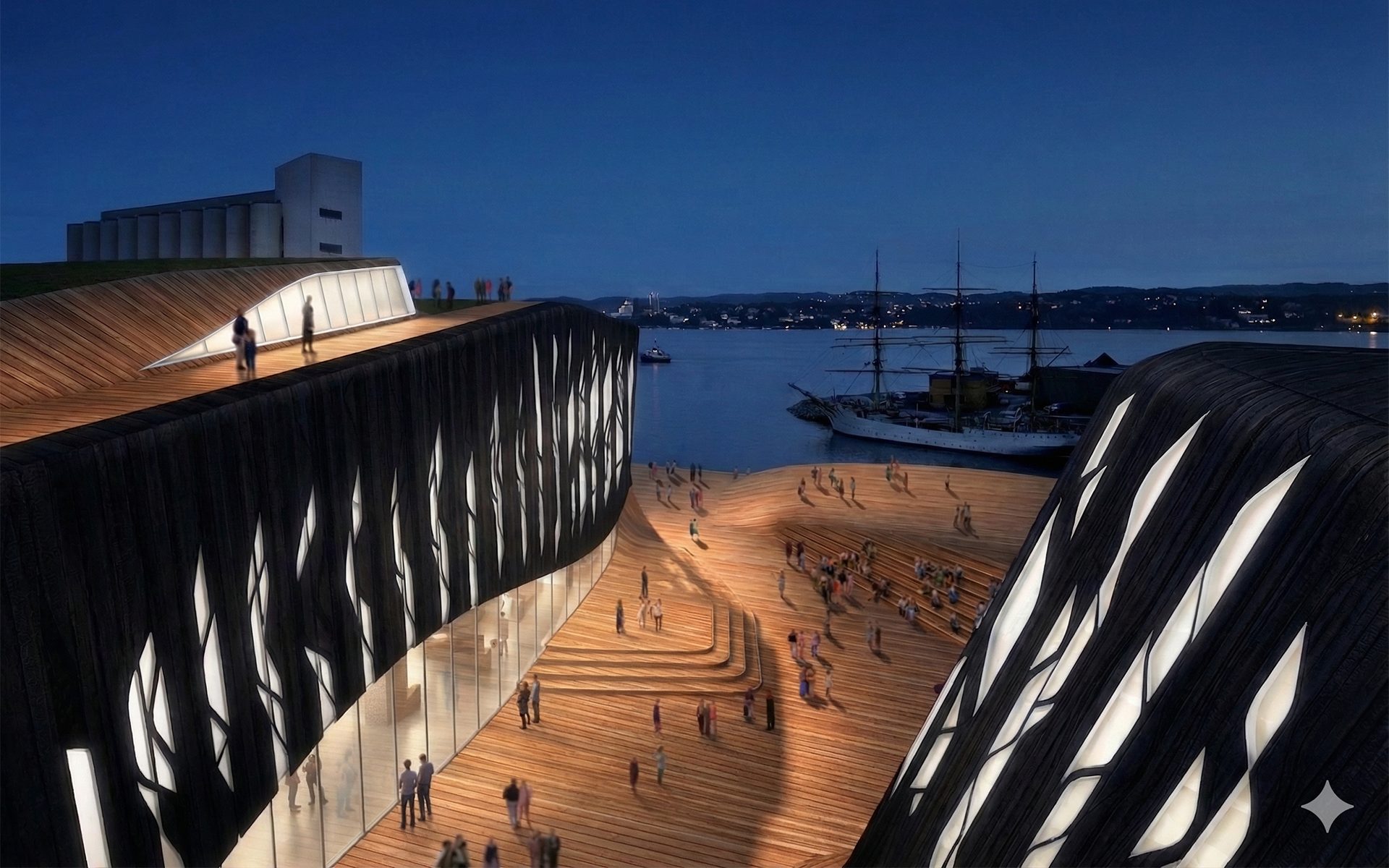
| Project Location | Kristiansand, Norway |
| Project Type | Performing arts centre, concert hall, theatre, opera house, cultural building, public infrastructure |
| Project Description | Competition proposal for a performing arts centre in Kristiansand integrating concert hall, theatre and opera spaces beneath a continuous timber canopy shaped by urban geometry and acoustic strategy. |
| Architect | UFO Architecture |
| UFO Project Team | Jonas Lundberg, Katarina Larsdotter, Andrew Yau, Zlatko Haban, Aaron Casey, Claudio Lucchesi, Anna Liuzzo |
| Consultants | Environmental Design: Francesca Galeazzi; Structural Design: Daniel Bosia, Ove Arup |
| Project Status | Competition – unbuilt |
| Project Duration | 2004 |
| Programme | 1,200-seat concert hall expandable to 1,350 seats, theatre, opera house, public foyers, shared logistics, workshops, service areas and civic public spaces |
| Design Focus | Urban geometry, timber canopy, cultural infrastructure, acoustic isolation, box-in-box auditoria, public surface, theatre flexibility, opera acoustics, logistics and waterfront connection |
| Urban Strategy | The project mediates between the Odderøya grid, the Gravane canal orientation and Kristiansand’s quadrature grid, producing a controlled misalignment of volumes beneath a unified timber roof. |
| Acoustic Strategy | Auditoria are designed as acoustically isolated concrete volumes using box-in-box construction, vibration bearings, double-wall assemblies, sound traps and acoustic modelling for external vibration control. |
| Performance Spaces | The concert hall enhances orchestral reflection through controlled surfaces and ceiling reflectors; the theatre prioritises speech clarity and flexible seating; the opera house balances vocal projection with orchestral performance. |
| Logistics | A centralised logistics system provides discrete access to all venues through a shared loading bay, while workshops are served independently and public and back-of-house circulation remain separated. |
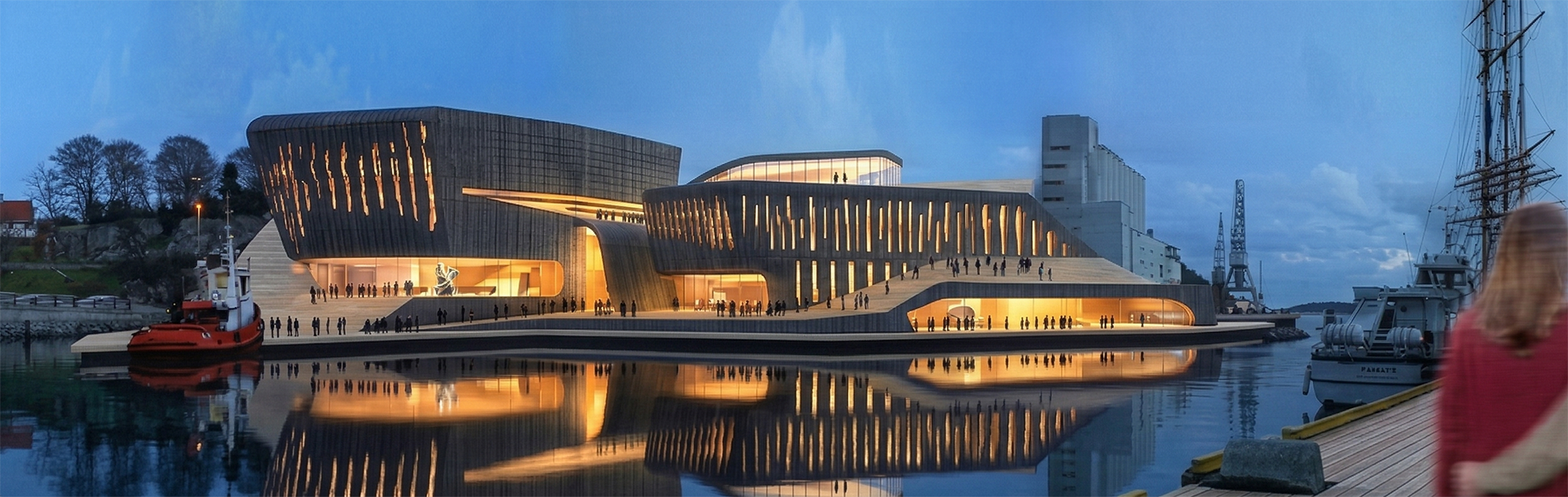
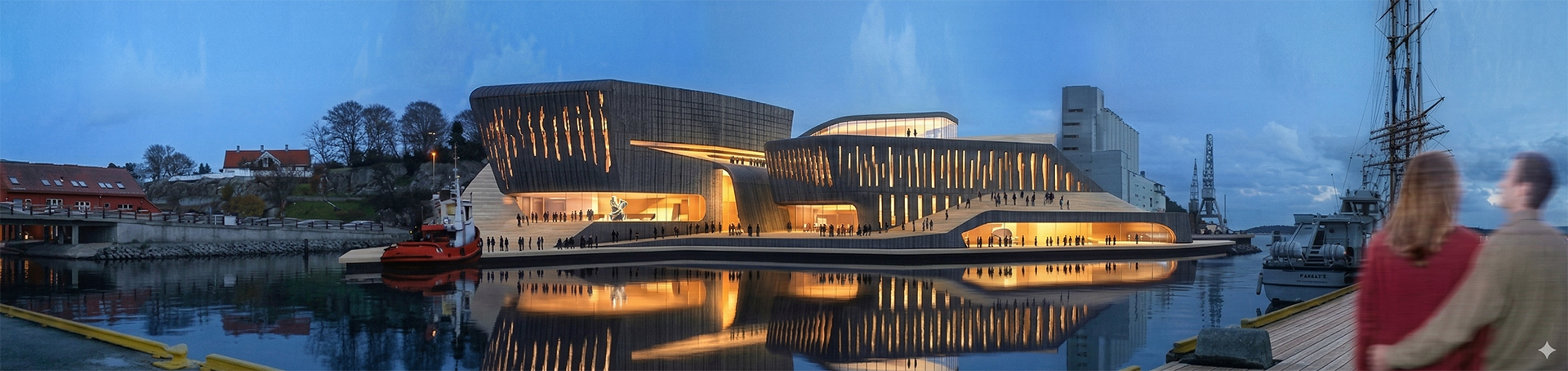
Kristiansand Performing Arts Centre is UFO Architecture’s competition proposal for a new cultural complex in Kristiansand, Norway. The project brings together the Kristiansand Symphony Orchestra, Agder Theatre and Opera South within a unified civic framework.
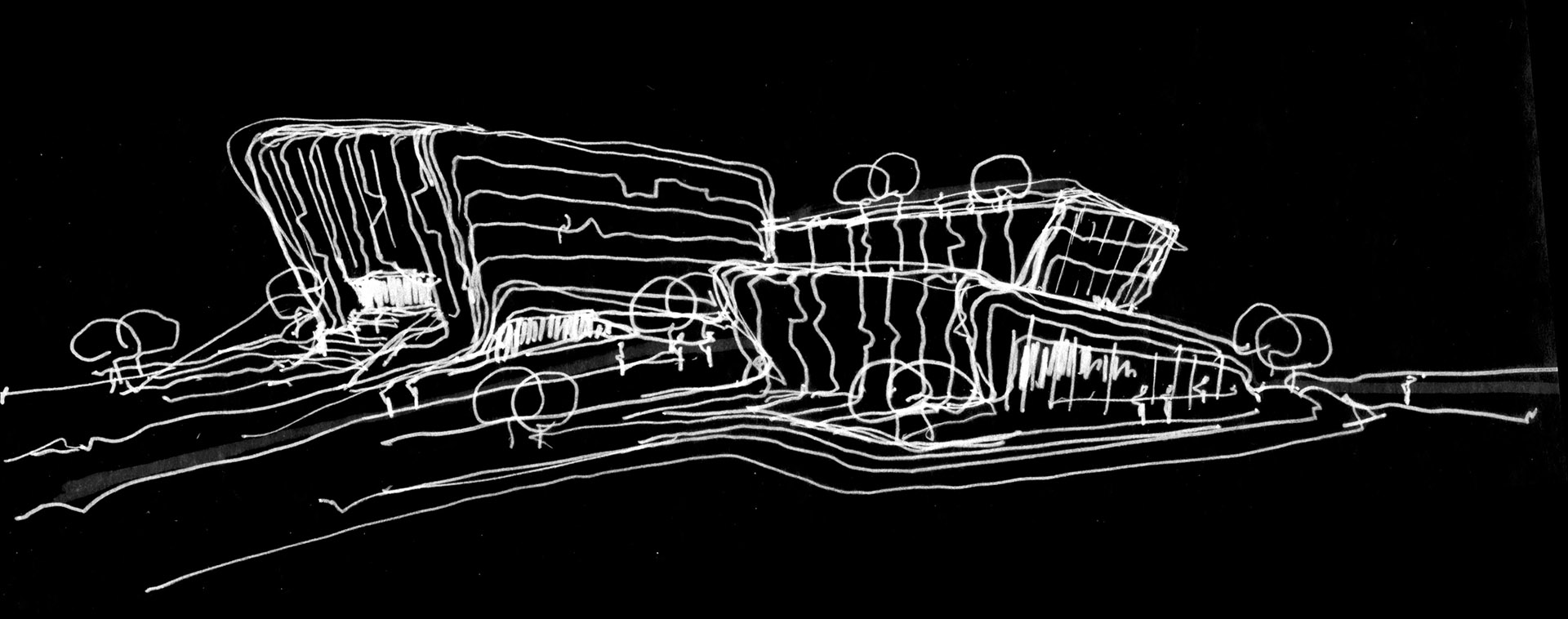
The proposal operates as both icon and infrastructure, extending the public realm into the building while resolving complex urban, acoustic and logistical conditions. Three primary performance buildings are gathered beneath a continuous timber canopy, forming a unified public surface that connects city, waterfront and cultural programme.
The organisation of the building is generated from the intersection of three urban geometries: the emergent grid of Odderøya, the linear orientation of the Gravane canal and Kristiansand’s quadrature grid. The project mediates between these systems through a controlled misalignment of volumes, aligning where continuity is required while shifting in response to the canal and adapting to local irregularities.
The auditoria are conceived as acoustically isolated concrete volumes using box-in-box construction mounted on vibration bearings. The concert hall, theatre and opera house each develop distinct acoustic strategies while remaining part of a unified cultural and urban composition.