A civic landscape masterplan where park, ecological infrastructure and public buildings merge into one continuous urban system

| Project Location | Reggio Calabria, Italy |
| Project Type | Urban redevelopment, masterplan, civic landscape, ecological park, public buildings, competition entry |
| Project Description | A competition entry for the urban redevelopment of Reggio Calabria, proposing a new civic and public framework where landscape, ecological infrastructure and public buildings merge into one continuous urban system. |
| Architect | UFO Architecture |
| Lead Architect | Claudio Lucchesi |
| Project Status | Competition entry |
| Project Year | 2006 |
| Programme | Urban park, ecological park, public buildings, civic spaces, waterfront connections, pedestrian routes, landscape infrastructure and public realm |
| Design Focus | Urban redevelopment, public realm, civic infrastructure, waterfront, Southern Italian context, ecological park, landscape urbanism and building-landscape integration |
| Urban Strategy | The proposal creates a coherent civic framework for Reggio Calabria, connecting the city fabric, waterfront, public spaces and new public buildings through a continuous landscape system. |
| Landscape Strategy | The project develops the park as an inhabitable civic surface that blends continuously into public buildings, allowing architecture, landscape and movement to form one integrated urban environment. |
| Ecological Strategy | The masterplan integrates an ecological park with landscape infrastructure for shade, water management, biodiversity, microclimate improvement and public recreation. |
| Public Building Strategy | The public buildings are conceived as extensions of the landscape rather than isolated objects, emerging from the park and supporting civic, cultural and social activity. |
| Waterfront Strategy | The proposal strengthens Reggio Calabria’s relationship to the Strait of Messina, creating new public connections between the city, waterfront and wider Mediterranean landscape. |
Reggio Calabria Urban Redevelopment is a 2006 competition entry by UFO Architecture for the regeneration of Reggio Calabria, the city at the southern tip of the Italian mainland, directly opposite Messina across the Strait of Messina. Led by Claudio Lucchesi, the proposal develops a new civic and landscape framework for the city, bringing together public space, ecological infrastructure, waterfront connections and public buildings.
The project addresses Reggio Calabria as both an urban and territorial condition. Its position facing Sicily gives the city a powerful geographic identity, but also demands a public realm capable of connecting the everyday city to the larger landscape of the strait, the waterfront and the Southern Italian context.
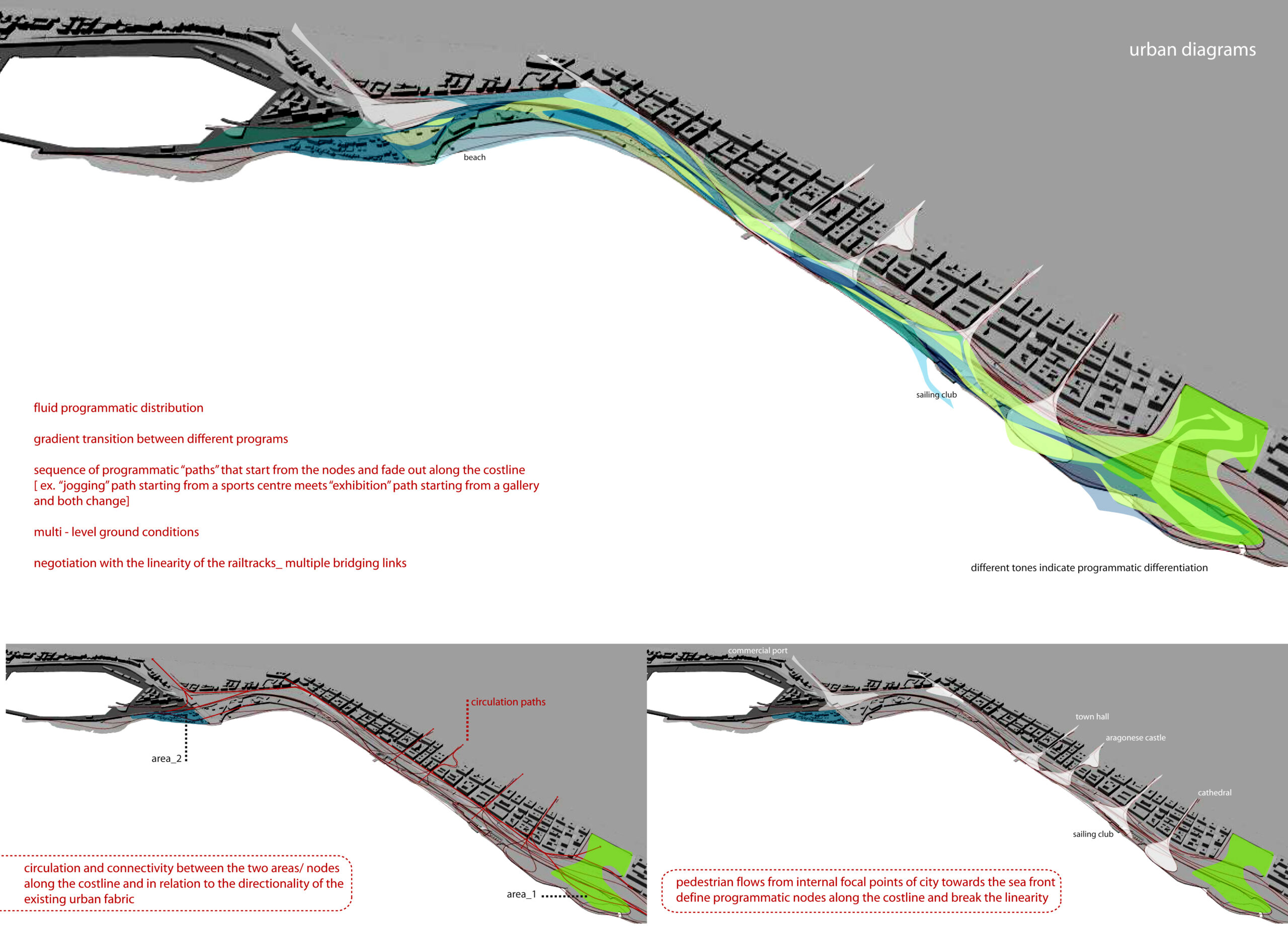
The proposal is conceived as a continuous civic landscape rather than a conventional masterplan of separate buildings and open spaces. Park, public routes, ecological systems and civic buildings are designed to blend into one another, creating a public ground that can be occupied, crossed, inhabited and extended over time.
At the centre of the strategy is an integrated ecological park. This park is not treated as decorative green space, but as urban infrastructure. It supports shade, water management, biodiversity, cooling, pedestrian movement and social activity, while also giving the redevelopment a clear environmental and civic identity.
The public buildings are embedded within this landscape system. Rather than standing as isolated monuments, they emerge from the park as extensions of the ground, allowing roofs, terraces, slopes and public interiors to form part of the same continuous urban experience. Architecture becomes part of the landscape, and the landscape becomes part of the public building.
The waterfront is understood as a key civic edge. The proposal strengthens the relationship between Reggio Calabria, the Strait of Messina and the wider Mediterranean horizon, creating new routes, viewpoints and public spaces that reconnect the city to its coastal geography.
The design reflects UFO Architecture’s broader interest in ecological urbanism, civic infrastructure and building-landscape integration. It proposes a form of urban redevelopment where public buildings, parkland, environmental systems and civic life are developed together as one spatial and environmental framework.
Reggio Calabria Urban Redevelopment positions landscape as the primary organising force of the city. The project suggests that regeneration in Southern Italian cities can be driven not only by new construction, but by the careful integration of public space, ecology, infrastructure and architectural form.